

The Siddha Sarahapadā states that whether we reside in a home or a forest, it is absolutely essential for us to gain clear knowledge of the true nature of our own mind. Awakening or pure consciousness (bodha) is continuously present everywhere. Therefore, looking for worldly existence (bhava) in one specific condition and looking for liberation (nirvāṇa) in another is nothing but pure foolishness. We only need to become closely acquainted with the secret that, at its root, the psyche (citta) is thoroughly pristine, spotless, and entirely free from mental constructs. This very state constitutes the supreme station (parama pada) for us, attaining which as absolute equilibrium (samarasya), wherever the psyche (citta) goes, we experience it solely in the form of the non-psyche (acitta). Upon attaining this pristine state, which is entirely free from presence or absence (bhāvābhāva-rahita), no matter where the psyche flashes forth, it awakens only to the true nature of the Lord (Nātha / the Radiant Self). Just as water and its waves are in reality one single, inseparable entity, similarly, the equilibrium of worldly existence (bhava kā sāmya) shares the exact same nature as the equilibrium of space (ākāśa).
The five aggregates (skandhas) named form (rūpa), sensation (vedanā), perception (saṃjñā), mental formations (saṃskāra), and consciousness (vijñāna); the five cosmic elements (tattvas) named earth, water, fire, air, and space; and the six sensory bases (āyatana indriyas) named eye, ear, nose, tongue, mind, and desire—all of these appear bound by their natural, conditioned character (sahaja svabhāva).
Therefore, it is essential for us to purify the mind that is intensely obsessed with mental constructs (saṅkalpābhiniviṣṭa man), rendering it devoid of its conditioned nature (niḥsvabhāva). This allows it to enter into the Void (śūnya) and arrive at the state of absolute equilibrium (samarasya). Just as water enters into water and merges completely, similarly, the psyche blends with the innate (sahaja) to arrive at the state of absolute equilibrium. The innate is the same outside as it is inside. It is continuously present across all the fourteen cosmic worlds (bhuvanas); it remains hidden inside this disembodied physical body. He who knows it is the one who is truly liberated.
Mahāsukha kā Utpatti Sthān – The Birthplace of Great Bliss
The birthplace of the aforementioned innate or Great Bliss (mahāsukha) found inside the body exists near the confluence of the two highly renowned energetic channels (nāḍīs) named Iḍā and Piṅgalā. It is absolutely necessary to attain this through the regulation of the internal wind (pavana).
- The moon channel (Lunar Nāḍī) named Lalanā (the nature of wisdom or prajñā-svarūpa) corresponding to the left nostril, and
- The sun channel (Solar Nāḍī) named Rasanā (the nature of skillful means or upāya-svarūpa) corresponding to the right nostril,
serve as the two distinct halves of that great bliss-lotus (mahāsukha-kamala). Its seed sprouts and grows within the water of the supreme sky (gagan ke jal meṃ), where Amitābha exists in the form of the supreme, blissful mass of light (parama ānanda prakāśa-puñjarūpa). Its primary central stem is Avadhūtī (the central channel) or the primordial energy (mūlaśakti), and its external manifestation is of the nature of the cosmic ego (haṅkāra) or the unstruck, primordial sound (anāhat śabda).
Perfected yogis and practitioners drink the sweet nectar (makaranda) of this great bliss-lotus inside the physical body solely through their spiritual practice (sādhanā). If a firm energetic lock is placed upon the external exit-gate of the body through which energy drains out, and if the lamp of a pure and motionless mind-wind (niścal man kā dīp) is kindled within that intense inner darkness, touching the supreme sky toward that Jinaratna (the victorious jewel), then even while experiencing the sensory objects of the world, the perfection of liberation (nirvāṇa kī siddhi) will be secured for us.
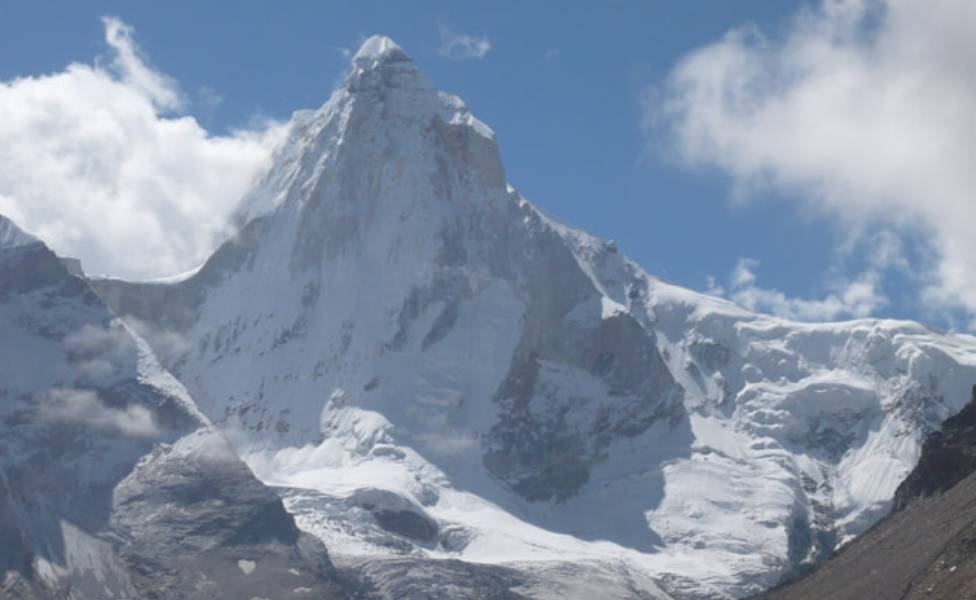
He whose mind has become perfectly motionless achieves the restraint of the internal wind (vāyunirodha) at that very instant. When the wind is restrained, the mind naturally becomes still on its own. There is a deep, mutual relationship between the two. The specific internal station where both the wind and the mind are rendered motionless together is called ‘Uḍḍumeru’ or the spinal column (Merudaṇḍa / Suṣumnā) by the Siddhas. This is just like the peak of a mountain—it is even and uneven; therefore, ascending and descending upon it cannot happen with ease. Within its deep, solemn cavern, the entirety of the phenomenal world becomes dissolved and merges into the Void (śūnya), and the pristine water of our fluid, restless psyche (citta) also becomes completely absorbed (tanmaya) into it. The Siddhas have declared that very summit of the high mountain to be the dwelling place of Mahāmudrā or the primordial energy (Mūlaśakti, also known as Nairātmā).
Nairātmā
The Siddha Śavarapā states that upon the aforementioned mountain, numerous grand trees are in full bloom, and their branches kiss the sky (gaganacumbinī). There, the solitary tribal woman Śabarī (Nairātmā) constantly wanders in the complete isolation of the forest. In that very place, the beautiful couch of the three elements (tridhātu) is also laid out. Attaining that station, the practicing yogi begins to pass time with intense love in the company of that Dārikā (divine maiden).
Apart from Śabarī, the Siddhas have addressed Nairātmā by names such as Ḍoṃbī, Caṇḍālī, Śuṇḍinī, Joiṇi (Yoginī), or Pavanadhāriṇī, describing her in diverse ways. Presenting a metaphor, they describe this Ḍoṃbīas constantly dancing atop a sixty-four-petaled lotus flower, and symbolize establishing a marital bond (vivāha-sambandha) with her. The Siddhas have declared her alone to be the one who swiftly ferries the practitioner across to lead them to Jinapura (the city of the victorious Buddha).
In the same manner, the Siddha Virūpā states that the solitary Śuṇḍinī (Kalālī, the brewer goddess) simultaneously forces the Iḍā and Piṅgalā channels to enter into the Suṣumnā channel on one side, while carrying the awakened mind-essence (bodhicitta) to firmly bind it within the radiant Void (prabhāsvara śūnya) on the other side. Near her, she holds the intoxication of great bliss (mahāsugha) securely balanced within sixty-four vessels (ghaṭī-yantras). Having reached that state even once, the intoxicated practitioner (madapī) never again utters the name of returning.
Designating their spiritual practice as the ‘Sahaj Mārga’ (the Innate Path), the Siddhas have described it as uniquely simple and straight. Regarding its straightness, the perfected ones state: when the existence of Nāda-Bindu or the discs of the moon and the sun does not remain, and the kingly psyche (cittarāja) is naturally liberated by its own inherent character, then how can it be considered proper to abandon this straight path and adopt a crooked, tortuous way (vakramārga)? The primordial awakening (bodhi) is ever present nearby; there is absolutely no necessity to travel to Lanka (a far-distant land) to find it. When the bangle (kaṅkaṇa) is already present right on the wrist, there will be no benefit derived from wandering around looking for a mirror to see it. Consider the Self to be eternally situated within one’s own mind. Only he crosses over safely who does not fall into the company of the wicked to stray onto a misguided path. For someone who adopts the straight, innate path (sahaja mārga), high-low, left-right—all distinctions dissolve into a single state of unity.
Similarly, the Siddha Bhādepā, describing its immense significance through his personal realization, states:
Until now, I was trapped in delusion. Now, through the awakening granted by the true Guru (sadgurubodha), I have achieved this pristine knowledge. My psyche (citta) has now become thoroughly extinguished and peaceful (naṣṭa / śānta), and within the ocean of the supreme sky (gagan samudra), the jewel — blending and fusing together, became a single identical form (tadākāra). Now, across all ten directions, I experience nothing but the absolute Void (śūnya hī śūnya). Through the instructions of the venerable Guru (vrajaguru), I have brought down that very ocean of the supreme sky (gagan-samudra) directly into my own mind.
Because describing the true, factual nature of the Innate (sahaja) is exceptionally difficult, instructions regarding its path cannot be deeply internalized without the clear clarity of personal realization. For this reason, the Siddha Kāṇhapā states—whatever is spoken on this subject appears entirely false. The Guru, in reality, is mute, and the disciple is deaf. How then can a description of that ultimate reality—which transcends the very pathway of speech (vākpathātīta)—be possible?
Mantra Japa Sādhana – The Practice of Mantra Recitation
Immense glory is attributed to recitation (japa) within the scriptures. Compared to all ritual sacrifices (yajñas), the sacrifice of recitation (japa-yajña) is declared to be supreme. The sacrifice of recitation requires no external ingredients, physical materials, or violence (hiṃsā). It is stated in the Padma Purāṇa and Nāradīya Purāṇa that the collective sum of all ritual sacrifices does not equal even a sixteenth part of audible, vocal recitation (vācika japa). Furthermore, compared to vocal recitation, whispering recitation (upāṃśu japa) yields a hundred times more fruit, and mental recitation (mānasa japa) yields a thousand times more fruit.
- Mānasa Japa (Mental Recitation) is that in which, while contemplating the internal meaning, a person repeatedly reviews the phonemes (varṇas), vowels, and words of the mantra purely within the mind.
- Upāṃśu Japa (Whispering Recitation) is that in which the tongue and lips move slightly, and its sound remains limited strictly to one’s own ears, such that no other person can hear it.
- Vācika Japa (Vocal Recitation) is the direct vocalization through the organ of speech.
In all three types of recitation, the mind must continuously contemplate the chosen deity (iṣṭa). Performing a mental recitation of a hymn (stotra-pāṭha) or loudly shouting a mantra—both of these actions are entirely fruitless.
It is stated in the Gautamīya Tantra:
A mantra that exists merely in the form of written or spoken letters is in a state of inertness (jaḍatā) or animality (paśutā). When it is vocalized and vibrated through the central channel (suṣumnā), the transmission of divine power (śakti-sañcāra) takes place within it.
First, one must cultivate the firm contemplation that every single syllable of the mantra is interwoven with the consciousness-energy (cicchakti) and is firmly established within the supreme, nectar-filled sky of consciousness (cidākāśa). Cultivating this contemplation while reciting allows the mantra to manifest its innate power on its own, completely bypassing the need for ritual worship, fire sacrifices (homa), or external ceremonies.
The precise method for performing mantra recitation is as follows: directing the vital awareness (prāṇabuddhi) to the baseline region of the suṣumnā channel, one must contemplate the mantra as identical with the individual life-soul (jīvarūpa). Armed with a complete knowledge of the mantra’s meaning (mantrārtha) and the consciousness of the mantra (mantracaitanya), the recitation should be executed. In the Kulārṇava Tantra, Lord Śaṅkara states: if the mind is in one location, Śiva is in a second location, Śakti is in a third location, and the vital breath (prāṇa) is in a fourth location—in such a fragmented state, what possibility can there be for achieving mantra perfection (mantra-siddhi)? Therefore, one must execute the recitation while focusing and contemplating all of these elements together as a single unity.
Final Notes
Please note, that these explanations are for the purpose of learning and understanding. As we will discuss in future articles, the act of the guru in transmitting these mantras results in the Enlivening, Awakening, and clearance of all mantra defects. Within our parampara, we have before us the methods of awakening any mantra, and secondary, the methods of enlivening and removing mantra-doshas. These consist of a combination of very special practices, including the use of various mantras, fire rituals, visualizations, and various combinations of the above. In the end, the goal is to reach a state of equilibrium between Paramātmā and the given mantra. It is very true that, for this to be accomplished without a guru, is a heroic task, because if the processes are successfully being preformed, one will spontaneously experience strange stated and one will even be flung from their body into spontaneous alternate states of consciousness. As heroic as everyone thinks they will be when this happens, it will cause terror to any individual who happens to experience this.
The terror is so extreme, because it is a matter of one’s reality all coming apart. While this is a wonderful thing, which will lead to union with the divine, doing so alone is an impossible task, and hence the necessity of a guru is present. Keep in mind, even great beings such as Gorakhnath, Matsyendranath, and others— great beings who are like gods compared to us- real immortals and siddhas who can traverse the realms and the boundless cosmos— they even needed a Guru.
It is true that there are some, far and few, who succeed alone. But it should be known that they are forest dwellers who take the most extreme path. They themselves also, as far as we know, tend to have aid from some form of being or god which manifests and accompanies them.
The purpose of saying all of this is not to induce fear, but to explain the reasoning behind why even if one has these secret methods, it is best to find a guru, because success in sadhana is a hopeless battle without a guru.
So, given our responsibility, we will not be deposing these methods to the public, nor encouraging anyone to attempt these methods. But, if one has already received mantra diksha and has displayed good conduct and consistency in their practice, as well as a good nature and seeking higher goals, I will be willing in very special circumstances to provide some knowledge on empowering a mantra in which one has already received diksha.
Comment
You must be logged in to post a comment.