

In order to yield success with a mantra, it is important that the sadhaka aligns properly with the mantra (which, we know itself to be the deity in totality). It is stated in the text ‘Sarasvatī Tantra’ that prior to chanting mantras, knowledge of its kullukā is also essential. At the time of commencing chanting, whichever mantra is to be chanted, its kullukā should be established upon the head— meaning one should perform its ritual placement (nyāsa) upon the crown of the head. The kullukā mantras for certain deities are given here –
- Tārā mantra’s kullukā: Oṃ Hrīṃ Strīṃ Hūṃ
- Kālī mantra’s kullukā: Oṃ Krīṃ Hūṃ Strīṃ Hrīṃ Phaṭ
- Chinnamastā mantra’s kullukā: Oṃ Śrīṃ Hrīṃ Hlīṃ Aiṃ Hrīṃ Klīṃ Svāhā
- Vajravairocanī mantra’s kullukā: Oṃ Śrīṃ Hrīṃ Hlīṃ Aiṃ Hrīṃ Klīṃ Svāhā Hūṃ
- Bhairavī mantra’s kullukā: Oṃ Haṃ Sa rāiṃ
- Tripurasundarī mantra’s kullukā: Oṃ Aiṃ Klīṃ Sauḥ Tripure Bhagavati Svāhā or Klīṃ
- Mañjughoṣā mantra’s kullukā: Oṃ A Ra Va Ca La Dhīḥ
- Bhuvaneśvarī mantra’s kullukā: Oṃ Hrīṃ
- Viṣṇu mantra’s kullukā: Oṃ Namo Nārāyaṇāya
- Mātaṅgī mantra’s kullukā: Oṃ
- Dhūmāvatī mantra’s kullukā: Oṃ Hrīṃ
- Ṣoḍaśī mantra’s kullukā: Oṃ Śrīṃ
- Lakṣmī mantra’s kullukā: Oṃ Śrīṃ
- Sarasvatī mantra’s kullukā: Oṃ Aiṃ
- Annapūrṇā mantra’s kullukā: Oṃ Klīṃ
- Śiva mantra’s kullukā: Oṃ Hauṃ
For other deities, their respective root mantras function as their own kullukā.
Mantra-Setu (The Mantra Bridge):
Primarily, the bridge (setu) for mantras is the syllable Praṇava (Oṃ). For Brahmins and Kshatriyas, the bridge is Praṇava (Oṃ); for Vaishyas, it is Phaṭ; and for Shudras, the bridge is Hrīṃ. It is important to note that in the modern day, there will be some confusion surrounding a matter of which caste a person does align. Prior to beginning mantra chanting, one should chant this bridge syllable within the heart center.
It is in my personal opinion that one who is born outside of the caste system, should assume they belong to the caste of whichever profession they operate. Those who work in education, religion, or selfless service to humanity may assume themselves to be Brahmin. Those working in any military or administrative position may assume to be Kshatriyas. Those working in business as Vaishyas. And those working as laborers as Shudras. If one is able to undergo extensive analysis of birth chart and other things, it may be determined that they are meant to be considered as another caste, if a Qualified Person is able to determine this. The qualified person must have a thorough understanding of both jyotish and shastra in order to come to a determination such as this.
Please note that this should not be viewed as “one is better than the other” in some sort of way. This is a matter of interaction between the mantra and the heart center, based upon the action and activity in one’s life, which will determine what will and what will not work. If you spend your days conducting business or labour, and chant the syllable of Brahmin or Kshatriya simply because you see it as a higher status, it will very likely simply Fail to interact with your karmas and Fail to generate the intended result.
Mahāsetu (Great Bridge):
Prior to chanting a mantra, the mahāsetu is chanted. By chanting this, one receives the authorization to perform mantra chanting at any time and in any physical condition. The mahāsetu for Tripurasundarī is Hrīṃ, for Kālikā it is Krīṃ, and for Tārā it is Hūṃ. For all other deities, the mahāsetu is Śrīṃ. Its chanting should be performed within the viśuddha cakra (throat center).
Nirvāṇa:
First, utter Praṇava (Oṃ), and thereafter, pronounce all the vowel sounds starting with A (up to Aḥ), then recite your core mantra. Following that, chant Aiṃ, then all the vowel sounds again, and conclude by chanting Praṇava (Oṃ). One should perform this encased (sampuṭita) chanting method within the maṇipūra cakra (navel center). This process is named nirvāṇa.
Mukhaśodhana (Mouth Purification):
Experts in the scripture of mantras (mantra-śāstra) hold the opinion that one must perform mouth purification prior to mantra chanting. This is because chanting with an impure mouth brings harm instead of success. Various types of impurities reside upon the tongue— the impurity of food, the impurity of speaking lies, and the impurity of quarreling. Without purifying these, the tongue does not become fit for uttering mantras. Therefore, the method for tongue purification is prescribed in the scriptures. Whichever deity’s mantra is being practiced, one should first chant that specific mouth-purification mantra ten times. These purification mantras are as follows:
- Tripurasundarī: Śrīṃ Ūṃ Śrīṃ Ūṃ Śrīṃ Ūṃ
- Śyāmā: Krīṃ Krīṃ Krīṃ Ūṃ Ūṃ Ūṃ Krīṃ Krīṃ Krīṃ
- Tārā: Hrīṃ Hūṃ Hrīṃ
- Durgā: Aiṃ Aiṃ Aiṃ
- Bagalāmukhī: Aiṃ Hrīṃ Aiṃ
- Mātaṅgī: Ūṃ Aiṃ Ūṃ
- Lakṣmī: Śrīṃ
- Dhūmāvatī: Ūṃ
- Dhanadā: Ūṃ Dhaṃ Ūṃ
- Gaṇeśa: Ūṃ Gaṃ
- Viṣṇu: Ūṃ Haṃ
For other deities, simply the Praṇava (Oṃ) syllable serves as the mouth-purification mantra. One must chant it ten times prior to mantra japa.
Prāṇayoga (Infusing Vital Breath):
Just as a body filled with vital breath (prāṇa) becomes active and alive, similarly, a mantra filled with vital breath achieves success. Its method is simply this: one should frame or encase (sampuṭita) their core mantra with the māyā-bīja, meaning Hrīṃ, and chant it seven times.
Dīpanī (Illumination):
Just as the darkness of a house is eliminated by a lamp (dīpaka) and all the objects within it become visible, similarly, through the dīpanī ritual, the mantra becomes radiantly illuminated. This dīpanī ritual is simply this: prior to starting your regular mantra chanting, encase the core mantra with the Praṇava (Oṃ) syllable and chant it seven times.
The Eight Flaws of a Mantra (Mantra Doṣa)
In the text ‘Haritattvadīdhiti’, eight flaws of a mantra are enumerated, which are sequentially as follows—abhakti (lack of devotion), akṣarabhrānti (syllable confusion), lupta (omitted components), chinna(severed/broken), hrasva (shortened pronunciation), dīrgha (overly elongated pronunciation), kathana (vocal disclosure), and svapnakathana (revealing it in a dream).
- Abhakti (Lack of Devotion): Considering a mantra to be merely a structural collection of letters and alphabet syllables is defined as abhakti, according to the philosophical perspective. Those who perform chanting with the experiential realization that “the mantra is the very form of the deity,” experiencing supreme bliss (paramānanda) with the utterance of every single letter, achieve siddhi very rapidly. However, those who view the mantra as a mere word matrix, or those who look down upon their own mantra while considering someone else’s mantra to be superior, do not attain success; instead, they receive opposite, harmful results. To eliminate this abhakti, one should perform an intense amount of mantra chanting. When the presiding deity of the mantra becomes pleased through chanting (japa), fire ritual (havana), and austerity (tapasya), then devotion dawns within the seeker. Once devotion awakens, there is no delay in attaining siddhi.
- Akṣarabhrānti (Syllable Confusion): When the letters of a mantra become altered, scrambled, or if an extra letter is accidentally added due to the confusion or negligence of either the Guru or the disciple, it is called akṣarabhrānti. If this occurs, one must receive the mantra all over again from the Guru. In the Guru’s absence, it should be received from the Guru’s son or from any other qualified, advanced seeker.
- Lupta (Omission Flaw): A deficiency or complete omission of any specific letter or syllable within a mantra is the lupta flaw. For correcting this as well, there is an absolute necessity to receive the mantra anew.
- Chinna (Severed Flaw): It is called the chinna flaw when any integral component within a conjunct or compound letter is left out during pronunciation. This flaw is also rectified only through the exact same protocol mentioned above (re-initiation).
- Hrasva (Shortening Flaw): Pronouncing a naturally long vowel as a short vowel during chanting is the flaw named hrasva.
-
- Dīrgha (Over-Elongation Flaw): Pronouncing a naturally short vowel as a long vowel during chanting is the dīrgha flaw.
- Kathana (Vocal Disclosure Flaw): Intentionally or casually revealing your personal mantra to anyone else while in the waking state is the kathana flaw.
- Svapnakathana (Dream Disclosure Flaw): Revealing or telling your mantra to someone else within a dream state is the flaw named svapnakathana.
The remediation for the fifth and sixth flaws is done via the previously mentioned protocols (re-initiation or correction of vocal habit). However, the mitigation of the seventh and eighth flaws happens by surrendering and confessing at the feet of Śrī Gurudev; it is accomplished by executing whatever specific penance (prāyaścitta) ritual he prescribes. One must perform mantra chanting only after avoiding these eight types of defects; only then is siddhi achieved.
If, even after performing a full mantra ritual (anusthāna) with faith and strict adherence to the rules, success is not achieved, then one must perform that ritual repeatedly. If the mantra is still not perfected even after performing the full ritual three consecutive times, then one must employ the following seven remedial remedies. There is no necessity to perform all of these together at once. Through these, success is inevitably obtained. Those remedies are as follows:
Bhrāmaṇa, Rodhana, Vaśya, Pīḍana, Poṣaṇa, Śoṣaṇa, and Dāhana. For the purposes of most sadhakas, only the first two will ever be necessary. They are detailed here as follows:
- Bhrāmaṇa (Whirling/Scattering): It is called bhrāmaṇa when a mantra is woven or intertwined (grathita) with the air-element seed syllable (Yaṃ). On a ritual diagram (yantra), one must encase (sampuṭita) the entire series of letters of the mantra in an alternating sequence—one air seed syllable followed by one letter of the mantra. Thereafter, mix liquid storax (śilārasa), camphor (karpūra), saffron (kuṅkuma), vetiver (khasa), and sandalwood (candana) together, and use this paste to write out the entire prepared mantra combination onto the yantra. Submerge the written yantra into a mixture of milk, ghee, honey, and water, and perform the full counts of chanting (japa) and fire oblations (homa). By performing the ritual in this manner, the mantra is achieved success very quickly.
- Rodhana (Obstruction/Confinement): Encasement (sampuṭita) of the core mantra with the speech seed syllable (Aiṃ), followed by chanting it to the best of one’s capability, completes the rodhana ritual.
The Ten Sacraments of Mantras
The Shiva-devotee Ravana states: It is absolutely essential to perform the purifying sacraments on mantras that have been acquired without a living Guru or which lack the transmission of shaktipath. For self-perfected (svayaṃ siddha) mantras and mantras directly bestowed by a Guru, there is no such absolute necessity; however, for all other mantras, this is mandatory. This is because no ordinary mantra can escape the fifty distinct structural flaws, such as being severed (chinna), blocked (ruddha), powerless (śaktihīna), or turning its face away (parāṅmukha). Almost all common mantras are found afflicted with some defect or another. To eliminate these flaws, one must perform the following ten sacraments on the mantra:
doṣānimānavijñāya yo mantrān bhajate jaḍaḥ |
siddhirna jāyate tasya kalpa-koṭi-śatairapi ||
That foolish person who chants mantras without recognizing these flaws will not achieve success even if they continue chanting for hundreds of crores of cosmic cycles (kalpas).
- First Sacrament — Janana (Birth): Immediately after extracting the mantra (mantroddhāra), wash the yantra and place it into pure water.
- Second Sacrament — Dīpana (Illumination): Encasing the core mantra with the Haṃsa mantra and chanting it one thousand times constitutes the second sacrament named dīpana. For example—Haṃsaḥ Śivāya Namaḥ So’ham.
- Third Sacrament — Bodhana (Awakening): Performing five thousand chants of the core mantra encased with the Hūṃ seed syllable constitutes the third sacrament named bodhana. For example—Hūṃ Śivāya Namaḥ Hūṃ.
- Fourth Sacrament — Tāḍana (Striking/Purifying): Performing one thousand chants of the core mantra encased with the Phaṭ syllable constitutes the fourth sacrament named tāḍana. For example—Phaṭ Śivāya Namaḥ.
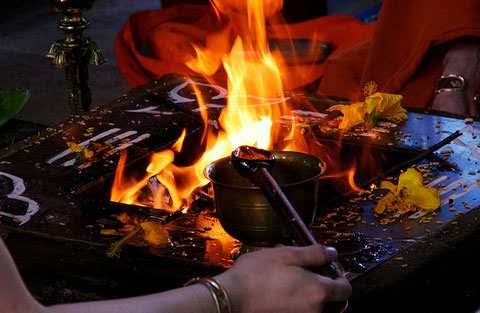
- Fifth Sacrament — Abhiṣeka (Consecration): Writing the mantra on a birch-bark leaf (bhojapatra), consecrating it with the phrase Roṃ Haṃsaḥ Oṃ, and sprinkling/consecrating the mantra using water that has been chanted over one thousand times, applied via a peepal tree leaf (aśvattha-patra) or similar vessel, fulfills the fifth sacrament named abhiṣeka.
- Sixth Sacrament — Vimalīkaraṇa (Purification/Clarification): Chanting the core mantra one thousand times while encased with the syllables Oṃ Troṃ Vaṣaṭ constitutes the sixth sacrament named vimalīkaraṇa. For example—Oṃ Troṃ Vaṣaṭ Śivāya Namaḥ Vaṣaṭ Troṃ Oṃ.
- Seventh Sacrament — Jīvana (Vivification/Revivification): Chanting the foundational mantra (mūlamantra) one thousand times while encased with the syllables Svadhā Vaṣaṭ constitutes the seventh sacrament named jīvana. For example—Svadhā Vaṣaṭ Śivāya Namaḥ Vaṣaṭ Svadhā.
- Eighth Sacrament — Tarpaṇa (Libation/Offering): Making one hundred ritual liquid offerings (tarpaṇa) using milk, water, and ghee while uttering the foundational mantra constitutes the eighth sacrament named tarpaṇa.
- Ninth Sacrament — Gopana (Concealment/Protection): Chanting one thousand times with the core mantra encased by the Hrīṃ seed syllable constitutes the ninth sacrament named gopana. For example—Hrīṃ Rāmāya Namaḥ Hrīṃ.
- Tenth Sacrament — Āpyāyana (Replenishment/Satiation): Chanting one thousand times with the core mantra encased by the Hauṃ seed syllable constitutes the tenth sacrament named āpyāyana. For example—Hauṃ Śivāya Namaḥ Hauṃ.
A mantra sanctified (saṃskṛta) in this manner becomes rapidly result-yielding and grants perfection (siddhi) swiftly.
The Kūrmacakra
Please note that with regards to the Kūrmacakra, which may be seen as complicated and difficult to understand, I intend to release a more comprehensive article and guide in the future detailing how this is properly done, with examples that are easy to follow.
The purpose of the Kūrmacakra is to determine what space within a region, house, room, or other division of physical space is most auspicious/results yielding for sadhana. It also helps us to understand what areas to avoid.
Whichever open land, sacred field (kṣetra), town, or house one intends to perform a major preparatory ritual invocation (puraścaraṇa) within, they must mentally divide that space into nine equal square sections. In the central section, write the vowel letters, and following the sequence starting from the East, write the consonant groupings starting with Ka-varga (the Ka, Kha, Ga, Gha, Ṅa series), etc. In the Northeast direction (īśāna koṇa), write La and Kha (or Kṣa).
Whichever square chamber contains the initial letter of the town or location’s name should be understood as the “mouth/head” (mukha) of the cosmic tortoise. The two sections on either side of it are the arms/shoulders (bhujā); the next two sections on either side are the flanks/sides (kukṣi); the next two sections on either side are the legs/feet (pair); and the remaining final chamber is considered the tail (pucchā). Performing mantra chanting while seated within the section designated as the mouth results in achieving siddhi. Seating oneself in the arms/shoulders section leads to a shortened lifespan (svalpa-jīvana); the flanks lead to indifference/apathy (udāsīnatā); the feet section brings suffering (duḥkha); and seating oneself in the tail section brings bondage, diseases, and acute pain (bandhana-vyādhi-pīḍā).
I would like to make a note that while there is a lot of information here, it is important to only attempt whatever degree of action you are able to reasonably perform consistently. Most importantly, a guru will help you in determining what actions are most necessary, and important and how to prioritize these actions. Finally, if under the grace of a guru, many doshas or afflictions which could otherwise exist for an individual, may very likely not even be there at all. So for anyone and everyone who seeks to commit to these practices, it is of paramount importance that one has a guru, and it is of great importance that one gives themself to the guru and dissolves within the guru entirely, so all things will be taken care of. This is a very beautiful thing, and the ease in life and in sadhana that comes from guru’s grace can never be said enough, even with a million words.
Sarvebhyo mangalam
Comment
You must be logged in to post a comment.