


Pranams to all, and a very auspicious ninth day of Navaratri.
Sarvebhyo Mangalam
I would like to begin this day; which represents a unique era of which I will be relaying a lot of knowledge to the public and hoping to make a change to those spiritual aspirants who seek out our guidance; with a certain establishment of intent of the divine nature, may all of you seekers have your ignorance cut and the path to divinity revealed.
I would like to begin today with a clear explanation of the three Gunas and their significance to Us, in the literal and practical sense. And the significance in practice.
Spiritual practices (Sadhanas) have two primary forms: Sattvik (pure) and Tamoguni (dark/veiled). Because Rajogun (the quality of passion) possesses no inherent direction of its own, when both types of practices are performed with the intent of obtaining luxury, worldly enjoyment, and opulence, they fall into the category of Rajoguni practices.
An ordinary person studying the scriptures is often astonished to find that the rules prescribe worship and practice for the exact same chosen deity (Ishta) in both a Sattvik and a Tamoguni manner. There is a universal rule for spiritual practices: “Devo bhūtvā devaṁ yajet”, which means one must become a god to worship a god. This implies that to worship a Sattvik deity, it is absolutely essential for one’s body and mind to be Sattvik.
If a practitioner’s disposition is not inherently Sattvik, Tantra provides a path for them as well. The essence of Tamogun is to veil or obscure. To remove this veil, it is necessary for the practitioner to perform selfless action (Nishkam Karma). For those whose disposition is predominantly dark (Tam Pradhan), the modernized scriptures prescribe no means other than action (Karma). However true Tantra establishes practices even for them.
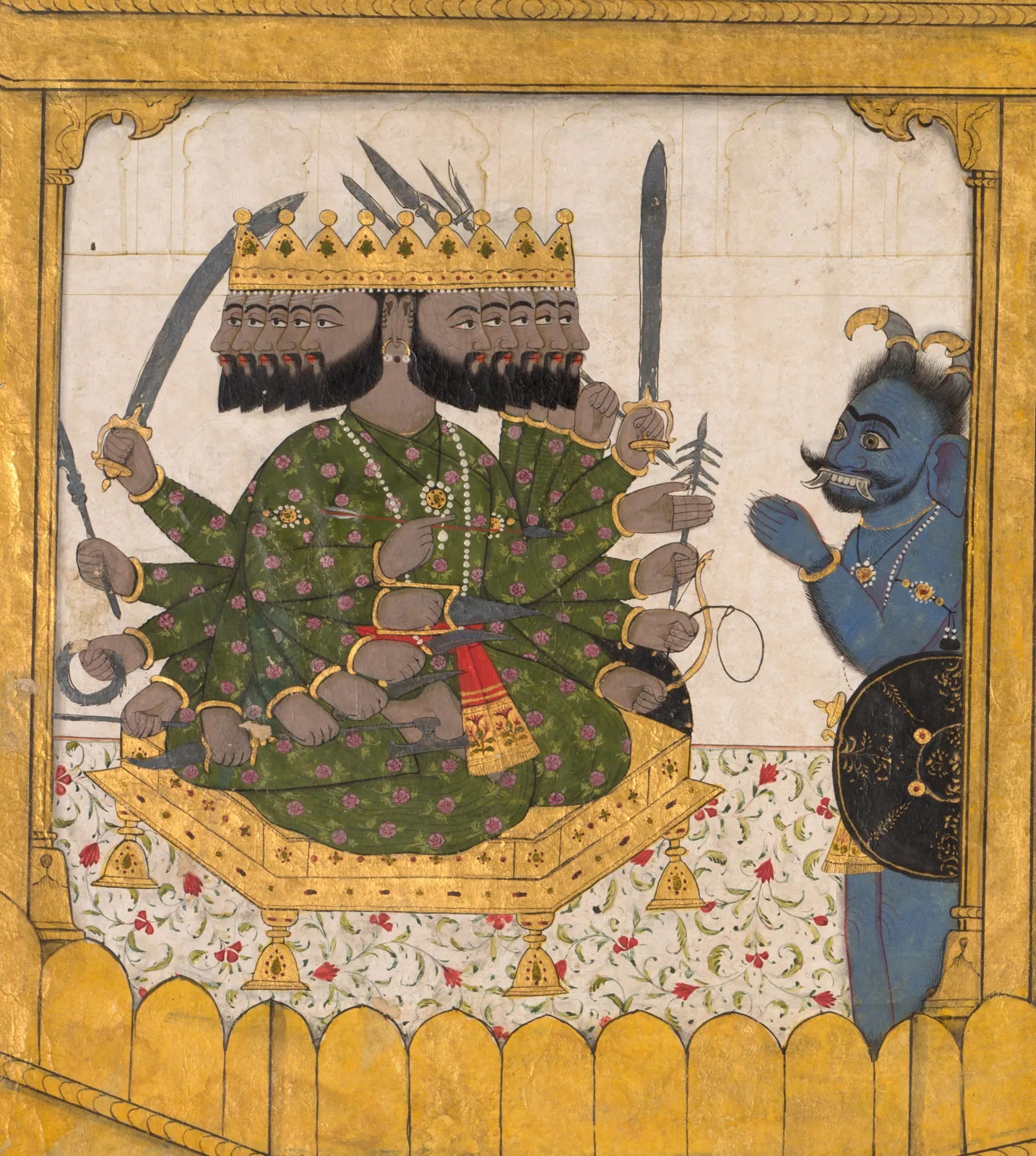
The Example of Ravana
Vishrava had told Kaikesi that because of the specific time she approached him with the desire for a child, the offspring born from that conception would be predominantly Tamoguni. That is exactly what happened. The environmental changes that occurred at the time of Ravana’s birth were clear omens of the horrors to come in the future.
Looking at Ravana’s life story, it becomes glaringly evident that even though he was deeply well-versed in the scriptures, he possessed a defiled and impure disposition. The flag of Ravana’s chariot was marked with a vulture. The vulture is a symbol of Asuric power. Knowing and understanding his own inherent nature, Ravana adopted the path of Tantra and achieved divine accomplishments.
The literal dictionary meaning of the word ‘Tantra’ is ‘thread’ or ‘yarn’. However, it also signifies a structured system or order. Even if we interpret it according to the dictionary, it means precise knowledge regarding the “what, why, and how” of every single thread composing the fabric of this universe.
This entire system is founded upon the teachings of Shiva. In this path, both Shiva and Shakti hold equal prominence. In its deeper dimensions, Tantra does not accept the two as separate entities. The Ardhanarishvara (the half-male, half-female form of Shiva) is the perfect ideal symbol of this concept.
Without the element of Shakti, Shiva is considered corpse-like (Shavatva). Therefore, female practitioners (Sadhikas) hold special importance in Tantric practices.
The items that conventional spiritual paths consider untouchable or Tamasik are actively used as instruments in Tantric practices. This often causes confusion among the general public. Tantrikas utilize these elements precisely so they can thoroughly recognize and understand the internal impulses that normally trigger reactions to external sensory stimuli.
In his epic Kumarasambhava, the great poet Kalidasa describes this specific form of Sadashiva and calls Shiva “Dhira” (the steadfast or unshakeable one). He refers to Parvati as Maya. He expresses wonder that even in the close presence of living Maya, Shiva attains deep meditative absorption (Samadhi). Maya naturally generates various modifications and disturbances in the mind.
The verse states: “Vikārahetau sati vikriyante yeṣāṁ na cetāṁsi ta eva dhīrāḥ”
- Meaning: “They alone are truly steadfast whose minds remain undisturbed even when the causes of mental disturbance are actively present.”
A Tantrika is also steadfast in this exact sense. The true character of a Tantrika is completely different from the popular misconceptions prevalent in society today. The spiritual practices performed by Ravana belong to the Mayik dimension of Tantra. There is inherent divinity in them, but a practitioner can easily deviate from the ultimate peak of Tantra depending on their underlying motives. In fact, discussions regarding these kinds of temptations—namely Siddhis (supernatural powers)—occur across all types of spiritual paths. Even those who perform Vedic fire rituals (Agnihotra) and divine sacrifices (Yajnas) sometimes stray from the path, despite those rituals being givers of liberation.
The thing is, the paths to reach the infinite, emotional Lord are also infinite. Just as a spider spins a web out of its own body and sits directly at its center, God creates this universe-cosmos and resides right in the middle of it. To reach the center from any point on the circumference of a circle, one can utilize various straight lines.
Just as straight lines are necessary, similarly, every individual soul situated on the circumference must practice distinct, individual spiritual disciplines to reach the focal point of creation.
Every living being possesses its own unique characteristics. Every soul is unprecedented, yet the ultimate destination for everyone is the same—the Supreme Brahman, the Supreme Soul / Paramatma, or the Supreme Lord / Parameshwara. He possesses infinite names, infinite forms, and infinite attributes. At the same time, He transcends names, forms, and attributes. His pure existence is beyond the reach of mind and speech, yet the human mind remains perpetually active in conceptualizing Him. Whatever a human being imagines with an impure body and unpurified mind remains defiled and unclear. However, as one’s body and mind become pure, the Divine reality becomes correspondingly pure and clear. Eventually, when the mind becomes completely free of thought-waves (Tarang-hin) and later dissolves into pure consciousness (Chaitanya), self-realization occurs. Through this, by Divine grace, ultimate perfection is achieved in the end.
Everyone, please contemplate heavily upon the subject matter. It is very important for understanding, and imposing the foundations necessary for the practice of Tantra, upon the self on many levels, and the contemplation of this knowledge imposes upon the body energetically, Jnana is the key to success in this path. Jnana exists within and around the body, so please do not underestimate the effects of understanding and contemplating upon knowledge.
Comment
You must be logged in to post a comment.