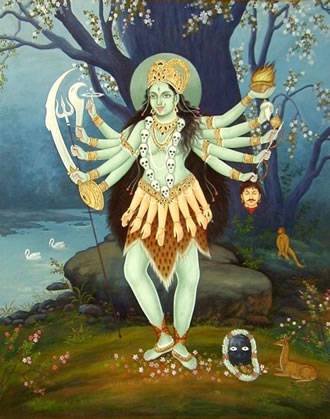
The presence of Tārā vidyā has been ubiquitous in recent times. Essentially, this vidyā lies in the permutation of Śrī kula into a krama of its own. This happens through the manipulation of śrī at two main levels; each successive level encodes a layer of mystery into the bīja and makes it more suitable for what her nature really is. Understandably, a full scope of who she is and how her energy manifested cannot be done in a single post; but we will begin by looking at these two transformations.
The first addition is adding the ‘t-kāra’ to śrī. Any student of Hindi or Sanskrit will know this results in the word strī, meaning woman. Tārā is the essence of what a woman is; in fact, she is the most uncovered tattva of femininity we will ever see.
The second addition is the addition of the ‘m-kāra’. Now this bīja is said in the Dakṣiṇāmūrti Saṃhitā to be the kilaka of the oṃkāra; in fact, ‘oṃ’ has just been extended from ‘m’. This viniyoga shows that the m-kāra and a special 4-akṣara nyāsa code are the true oṃ syllable.
When added to the strī bīja, we get the gupta bīja of Ugra Tārā herself. This is the feminine aspect of Oṃ, the śakti of oṃkāra. This principle is why she is called Brahmavidyā and Tāriṇī, or the one who ferries through the whole creation of oṃkāra and takes one to the other side.
The essence of Ugra Tārā is not understood easily. However, there are a number of recursive clues we can use to deduce what she really is. It is said Balarāma owns or possesses fully the śakti of Ugra Tārā Devī. She is also called Jātavedas or the fire from which the Vedas are born. Another thing is to analyze the life of her greatest sādhaks, such as Janārdana Buddha or Brahmānanda Giri. But all of these will only give one clue…
To really understand the nature of this unfathomably terrible goddess, one must go back to her origins, and her connection to one of the most powerful Navagrahas to ever exist.

Comment
You must be logged in to post a comment.